


Diwali 2026 falls on Sunday, November 8, 2026, on the night of Kartik Amavasya. The Lakshmi Puja Muhurat is 06:29 PM to 08:29 PM the window within Pradosh Kaal when puja carries the highest traditional merit. Below you will find the confirmed date, muhurat calculation, five-day schedule, regional variations, and a step-by-step FAQ for puja preparation.
Diwali 2026 At a Glance
| Festival | Diwali / Deepavali |
| Date | Sunday, November 8, 2026 |
| Hindu Month | Kartik |
| Tithi | Amavasya (New Moon) |
| Lakshmi Puja Muhurat | 06:29 PM to 08:29 PM |
| Pradosh Kaal | 06:01 PM to 08:40 PM |
Why Is the Lakshmi Puja Muhurat?
Most pages list the Diwali muhurat without explaining how it is calculated. Here is what the Panchang actually tells us.
The Lakshmi Puja muhurat on Diwali is set by the overlap of two astrological windows: Pradosh Kaal and the Amavasya tithi. Pradosh Kaal is the twilight period that begins approximately 45 minutes after sunset, a time considered deeply auspicious in Vedic tradition for invoking Lakshmi. Amavasya is the new moon night, the darkest night of the month, when the symbolic need for light is greatest and the ritual of lamp-lighting carries its fullest meaning.
According to classical Drik Ganit Panchang methodology, puja performed when Pradosh Kaal overlaps with the Amavasya tithi yields the highest ceremonial significance. For Diwali 2026, Pradosh Kaal runs from 06:01 PM to 08:40 PM. The Lakshmi Puja Muhurat 06:29 PM to 08:29 PM is the core of this window beginning after the first 28 minutes of Pradosh Kaal settle and ending before the window closes.
Why Is Diwali Celebrated?
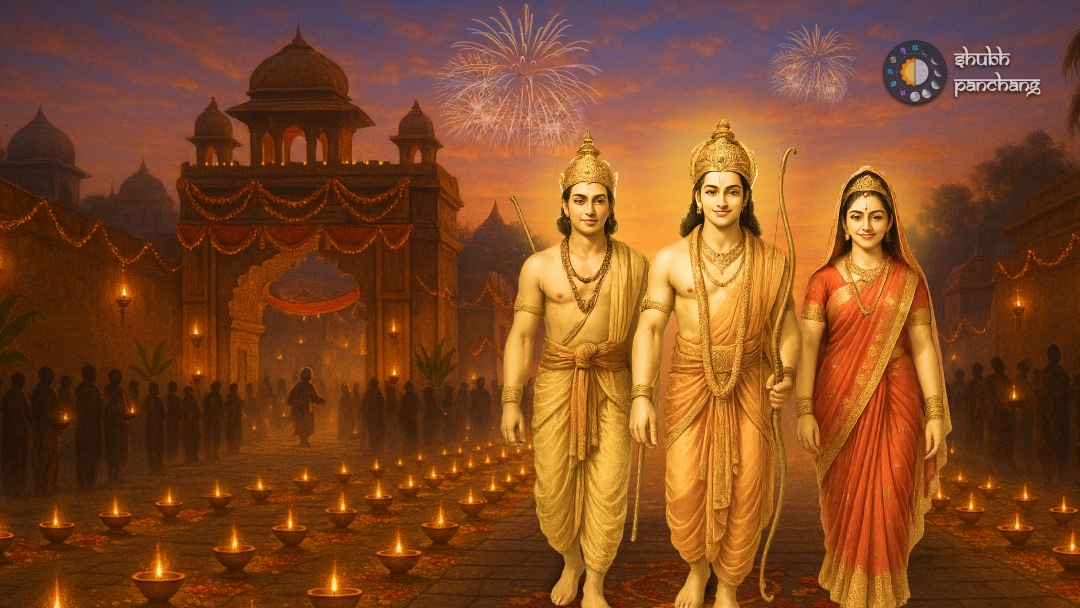
Diwali commemorates the return of Lord Rama to Ayodhya after fourteen years of vanvas (exile), following his victory over the demon king Ravana- as recounted in Valmiki's Ramayana, Yuddha Kanda. (Valmiki Ramayana, Yuddha Kanda) The night of his return was Kartik Amavasya: the darkest night of the month. The citizens of Ayodhya lit rows of oil lamps throughout the city so that Rama could find his way home. That act collective light against the new moon's dark — is what Diwali recreates each year.
Alongside the Ramayana narrative, Diwali is the primary occasion for Lakshmi Puja across most of India. Goddess Lakshmi is said to visit homes on Kartik Amavasya night entering clean, well-lit homes and blessing their inhabitants for the year ahead. For the business community, Diwali also marks the end of one financial year and the beginning of the next, rooted in the post-harvest accounting season that historically fell in Kartik month.
A third narrative, from the Bhagavata Purana, Tenth Canto, associates Diwali with Lord Vishnu rescuing Goddess Lakshmi from the demon Bali. All three narratives converge on the same essential symbol: the return of light, the arrival of prosperity, and the defeat of what oppresses.
Significance of Diwali
Diwali holds simultaneous religious, cultural, and economic significance and the weight of each varies by region and community.
Spiritually, Diwali embodies the Vedic concept of jyoti (divine light). In classical Vedic understanding, lighting a lamp is not decorative but philosophical: each flame represents the paramatma — the divine consciousness that dissolves avidya (ignorance). This is why the festival is called Deepavali (deepa = lamp, avali = row) and not simply "the night of one lamp." A single flame can be extinguished; a row of lamps is collective and resilient.
Socially, Diwali is observed across religious communities. Jain communities observe it as Mahavira's nirvana day (527 BCE). Sikh communities observe it as Bandi Chhor Divas — the day Guru Hargobind Singh ji was released from Gwalior Fort in 1619, celebrated at the Golden Temple in Amritsar with one of the largest illuminations in the Punjabi calendar.
How Diwali Is Celebrated
Lighting Diyas
The central act of Diwali is lighting earthen oil lamps diyas from dusk onwards across the home, courtyard, rooftop, and entrance. Traditional diyas burn mustard oil or pure ghee, though sesame oil is also used. The placement follows a deliberate logic: the entrance threshold is lit first (the path Lakshmi crosses when she enters), followed by window sills, staircases, the tulsi plant in the courtyard, and the puja room. In households that observe Naraka Chaturdashi separately, 13 diyas are lit facing south for departed ancestors — a distinct ritual from the Lakshmi Puja lamps.
Electric fairy lights have become a companion to earthen diyas in modern observance, rather than a replacement. The earthen diya lit by hand carries the ritual significance; the electric decoration is considered decorative.
Lakshmi and Ganesha Puja
The Lakshmi Puja is the festival's spiritual centrepiece and should be performed within the Muhurat: 06:29 PM to 08:29 PM on Sunday, November 8, 2026. The complete puja follows the Shodashopachara format — sixteen ritual offerings, including avahana (invocation), pushpa (flowers), dhupa (incense), deepa (lamp), naivedya (food offering), and dakshina (monetary offering). Lord Ganesha is worshipped before Lakshmi in every puja as the remover of obstacles, he is always invoked first. A new idol or image of both deities, placed on a clean red cloth, forms the altar.
Rangoli and Home Decorations
Rangoli — geometric or floral designs drawn at the home's entrance serves both an aesthetic and a ritual function. Traditional Diwali rangoli motifs include the lotus (Lakshmi's primary symbol), small footprints leading inward (representing Lakshmi entering), and the swastika (an ancient Vedic symbol of auspiciousness). Materials vary by region: coloured powders in North India; flower petals in Maharashtra and Gujarat; white rice flour (kolam) in Tamil Nadu and Karnataka. Rangoli is ideally completed before the Muhurat begins, so the entrance is prepared when Lakshmi is believed to arrive.
Sweets and Gift Exchange
The exchange of mithai and dry fruits with family, neighbours, and colleagues is universal across Diwali-observing communities. Traditional sweets are region-specific: kaju katli and gulab jamun in North India; chakli, chivda, and shankarpali in Maharashtra; obbattu in Karnataka; adhirasam in Tamil Nadu. The exchange of sweets is understood as an extension of the puja's prasad sharing the blessings received from Lakshmi outward into the community. Gift-giving has expanded in modern observance to include dry fruits, silverware, and in commercial contexts, corporate gifts.
Community Prayers and Celebrations
Temples across India observe extended puja schedules during the Diwali five-day period. Many conduct all-night bhajan and kirtan on Diwali night, keep their doors open throughout Pradosh Kaal for darshan, and distribute prasad at scale. Housing societies and local communities often organise collective rangoli competitions, diya-lighting ceremonies, and cultural programmes in the days surrounding Diwali.
The Five Days of the Diwali Festival
Diwali is a five-day festival. Each day has its own name, mythological narrative, and rituals — forming a continuous arc across Kartik Krishna Paksha and into Kartik Shukla.
Day 1 — Dhanteras
Dhanteras (dhan = wealth, teras = thirteenth tithi) falls on Kartik Krishna Trayodashi. It is the most auspicious day in the Hindu calendar for purchasing gold, silver, utensils, and metal items — the belief being that metal acquired on Dhanteras multiplies under Lakshmi's blessing throughout the year.
Dhanteras is also Dhanvantari Jayanti — the birth anniversary of the divine physician who emerged from the cosmic ocean during Samudra Manthan carrying the pot of amrita. Hospitals, pharmacies, and Ayurveda practitioners observe this with special prayers. A distinctive ritual involves lighting a diya facing south — the direction of Yamraj — as a protective prayer for the household's longevity.
Day 2 — Kali Chaudash / Naraka Chaturdashi
Known in North India as Choti Diwali and across the West and South as Naraka Chaturdashi or Kali Chaudash, this day marks Lord Krishna's defeat of the demon Narakasura. The most widespread ritual is the abhyanga snan — an oil bath taken before sunrise with sesame oil, symbolising the purification Narakasura's defeat represents. In Maharashtra, the abhyanga snan on this morning is a mandatory family tradition before any other activity.
In Bengal, this night is Kali Puja — as significant as Diwali in Bengali Hindu practice, involving midnight worship of Goddess Kali with elaborate ceremonies at home and in pandals.
Day 3 — Diwali and Lakshmi Puja
The main Diwali night. Lakshmi Puja is performed during the Muhurat 06:29 PM to 08:29 PM, homes are illuminated with diyas and lights, sweets are exchanged, and the new Hindu financial year begins with Chopda Puja for business communities.
The ritual logic of Diwali night centres on simultaneity: every home lit at the same time, every family invoking Lakshmi within the same Pradosh Kaal window, creates a collective welcome that individual observance alone cannot replicate.
For complete puja preparation guidance, muhurat calculation details, and the step-by-step Shodashopachara puja sequence, see the sections above.
Day 4 — Govardhan Puja
Govardhan Puja is observed on Kartik Shukla Pratipada. It commemorates Lord Krishna lifting the Govardhan Hill for seven days to shelter the people of Gokul from Indra's floods — as narrated in the Bhagavata Purana, Tenth Canto. The episode marks a theological turning point: Krishna redirected devotion from Indra toward Govardhan, establishing that the divine is present in nature itself.
In traditional observance, devotees create a symbolic Govardhan Hill from cow dung or mounded food and perform parikrama (circumambulation). In Gujarat, this day is Bestu Varas — the Gujarati New Year — one of the most important days in the Gujarati calendar, observed with elaborate prayers and new account books.
Day 5 — Bhai Dooj
Bhai Dooj (bhai = brother, dooj = second day) falls on Kartik Shukla Dwitiya and concludes the five-day festival. Sisters perform a tilak ceremony on their brothers' foreheads and pray for their long life; brothers offer gifts. The ritual parallels Raksha Bandhan but occurs in the post-Diwali period. The mythological origin connects to Yamraj visiting his sister Yami on this day — the first sibling reunion after cosmic creation. In Bengal the equivalent is Bhai Phota; in Nepal, Bhai Tika.
Diwali Across India — Regional Variations
Unlike what you may read on most Diwali pages, the festival is not observed identically across India. Regional tradition, theology, and calendar system produce meaningfully different celebrations:
Bengal: Diwali night is primarily Kali Puja. Homes and community pandals host elaborate Kali idols; midnight rituals are central. Lakshmi Puja holds less prominence than in North India.
Gujarat: Diwali concludes the Vikram Samvat calendar year. The day after — Bestu Varas is the Gujarati New Year, celebrated with particular intensity in the business community.
Tamil Nadu and Karnataka: Naraka Chaturdashi (Choti Diwali) is the primary celebration the early-morning oil bath before sunrise is the central ritual. The Ramayana narrative is secondary to the Krishna-Narakasura story here.
Maharashtra: Both Naraka Chaturdashi abhyanga snan and the main Lakshmi Puja are observed with equal importance. The preparation and exchange of faral — a tray of festive savoury and sweet snacks — with neighbours is a defining Maharashtrian tradition.
Punjab and Sikh communities: Diwali coincides with Bandi Chhor Divas, celebrating Guru Hargobind Singh ji's 1619 release from Gwalior Fort. The Golden Temple in Amritsar is illuminated on this night.