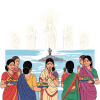



Ganesh Chaturthi 2026: Date, Puja Muhurat, Puja Vidhi and Visarjan
Ganesh Chaturthi 2026 falls on Monday, September 14, 2026, observed on Chaturthi Tithi of Shukla Paksha in the Bhadrapada month. Also known as Vinayaka Chaturthi and Ganeshotsav, it marks the birthday of Lord Ganesha — the deity invoked before every new beginning, be it a business, a wedding, a journey, or a home. The ten-day festival ends with Ganesh Visarjan on Friday, September 25, 2026. Below you will find the exact date, Tithi timing, Ganesh Puja Muhurat, step-by-step puja vidhi, Ganesha's birth story, fasting rules, and how the festival is celebrated across India.
Ganesh Chaturthi 2026 At a Glance
| Detail | Timing / Info |
|---|---|
| Festival | Ganesh Chaturthi / Vinayaka Chaturthi |
| Festival Date 2026 | Monday, September 14, 2026 |
| Hindu Month | Bhadrapada |
| Tithi | Shukla Paksha Chaturthi |
| Chaturthi Tithi Begins | Monday, September 14, 2026 at 7:06 AM |
| Chaturthi Tithi Ends | Tuesday, September 15, 2026 at 7:44 AM |
| Ganesh Puja Muhurat | 11:22 AM to 01:49 PM |
| Ganesh Visarjan Date | Friday, September 25, 2026 |
Ganesh Chaturthi Date and Tithi 2026
Ganesh Chaturthi falls on Chaturthi Tithi of Shukla Paksha in the Bhadrapada month every year. The date moves annually since it follows the Hindu lunar calendar. This year, the Chaturthi Tithi begins at Monday, September 14, 2026 at 7:06 AM and ends at Tuesday, September 15, 2026 at 7:44 AM, with the festival starting on Monday, September 14, 2026.
The Ganesh Puja Muhurat this year is 11:22 AM to 01:49 PM. This is the window most families and public pandals use for idol installation and Pranapratishtha. Planning the puja around this time is the traditional approach, and most Panchang recommendations point to this period as the best time to begin the celebrations on Ganesh Chaturthi day.
What Is Ganesh Chaturthi?
Ganesh Chaturthi, also called Vinayaka Chaturthi, is Lord Ganesha's birthday. Ganesha is worshipped across Hindu traditions as the remover of obstacles, the god of wisdom, and the presiding deity of new beginnings. No major ritual or undertaking in Hindu practice begins without first invoking him.
For most of its history, Ganesh Chaturthi was a household festival. In 1893, Bal Gangadhar Tilak turned it into a large ten-day public celebration to unite communities during the freedom movement against British rule, encouraging open Ganesh pandals where people from all backgrounds could gather. That format stuck, and today Ganeshotsav runs at both the family level and the community level across India and in Hindu communities abroad.
Ganesha's Birth Story:
The most widely told version of Ganesha's birth comes from the Shiva Purana. Goddess Parvati wanted a trusted guard, so she shaped a boy from the turmeric paste she was using for her bath and brought him to life. She stationed him at the door with instructions to let no one in while she bathed.
When Lord Shiva came home, the boy blocked his entry, following Parvati's orders. Shiva, not knowing the boy was Parvati's creation, grew angry and severed his head. Parvati was devastated when she saw what happened. To make amends, Shiva sent his followers to bring back the head of the first creature they found sleeping with its head facing north. They returned with an elephant's head, which Shiva attached to the boy's body and brought him back to life. Parvati accepted this form, and Shiva declared that Ganesha would henceforth be worshipped first before any god in every ritual and new undertaking.
A second account from the Brahma Vaivarta Purana says Ganesha was born directly to Parvati as a brilliant child blessed by Lord Vishnu, with the elephant head being part of his original form from birth. Different regional traditions follow different versions, but the core identity remains the same across all of them — Ganesha as the first among deities and the one who clears the path forward.
Ganesh Puja Muhurat 2026 and Why Timing Matters:
The Madhyahna Kaal, the midday period, is traditionally considered the best time for Ganesh Puja on Chaturthi, since Ganesha is believed to have been born during this part of the day. Performing the Pranapratishtha the ritual through which the deity is invited into the idol and the main puja within the Ganesh Puja Muhurat is how most families observe the tradition.
This year, the Ganesh Puja Muhurat is 11:22 AM to 01:49 PM. If you are installing a Ganesha idol at home, aim to complete the installation and begin puja within this window. If circumstances push the puja outside the Muhurat, it can still be performed while the Chaturthi Tithi is active.
One thing worth knowing: traditional belief holds that the moon should not be viewed on Ganesh Chaturthi night. This goes back to a story where the moon laughed at Ganesha and was cursed by him — anyone who sees the moon on this night, the story says, will face false accusations. Many devotees stay indoors after sunset or take care not to look at the sky that evening.
Ganesh Chaturthi Puja Vidhi:
Start with an early morning bath and clean the puja area thoroughly. Set up a raised platform or chowki with a red or yellow cloth and place the Ganesha idol on it, facing east or north. The puja thali should include Modak, Durva grass, red hibiscus flowers, Kumkum, Haldi, Akshat, Panchamrit (a mix of milk, curd, honey, ghee, and sugar), a diya, incense, sandalwood paste, and fresh fruits.
The full Ganesh puja follows the Shodashopachara format — sixteen steps of offering — beginning with Pranapratishtha. Here is the sequence:
Avahana — invite Ganesha into the idol by chanting Om Gan Ganapataye Namah.
Asana — offer a seat.
Paadya — offer water for the feet.
Arghya — offer water for the hands.
Achamana — offer water to sip.
Snanam — bathe the idol with Panchamrit.
Vastra — offer cloth.
Yajnopavita — offer the sacred thread.
Gandha — apply sandalwood paste.
Pushpa — offer flowers, especially red hibiscus and Durva grass.
Dhoop — offer incense.
Deepa — light the diya.
Naivedya — offer Modak and fruits.
Tambula — offer betel leaves.
Pradakshina — circle the idol.
Aarti — close the puja with Ganesha Aarti.
Chant the Ganesh Atharvashirsha during the puja, or repeat Om Gan Ganapataye Namah throughout. Distribute prasad Modak, coconut, and fruits after the puja is done.
Why Durva Grass and Modak Are Offered to Ganesha?
Durva grass is central to Ganesha puja for a specific reason. One story tells of a destructive asura named Analasura whom Ganesha swallowed to protect the world. The act left Ganesha with intense heat in his body. Sages offered him bundles of Durva grass, whose cooling properties gave him relief. Durva has been associated with Ganesha's puja ever since, offered as both a mark of devotion and a nod to that story.
Modak is Ganesha's favourite food offering. Made from rice flour dough filled with coconut and jaggery, the shape itself carries meaning: the outer shell represents the material world, and the sweet inner filling represents the spiritual bliss within. In Maharashtra, the steamed version called Ukadiche Modak is the traditional offering made at home, while fried Modak is more common in other states. Both are equally accepted in the puja.
Ganesh Visarjan on Friday, September 25, 2026:
Ganesh Visarjan is the immersion of the Ganesha idol in water, marking the end of Ganeshotsav. This year, Visarjan falls on Friday, September 25, 2026, which is Anant Chaturdashi. On this day, families and community groups carry their Ganesha idols through the streets in processions filled with music, dancing, flowers, and the chant of Ganpati Bappa Morya, Pudhchya Varshi Lavkar Ya, which means "Lord Ganesha, come back soon next year."
When the idol reaches the water, a river, lake, or sea, it is immersed, and the clay gradually dissolves. The belief is that Ganesha takes the prayers and problems of his devotees back with him to his divine home, and the dissolution of the idol back into the earth completes the cycle of the festival.
Not everyone waits until the tenth day for Visarjan. Many families do it after one and a half days, and others choose the fifth or seventh day. The tenth day, Anant Chaturdashi, is the largest, with the biggest processions and the most public immersions.
Eco-friendly Ganesh idols made from natural clay, paper pulp, or seed-based materials have gained significant ground in recent years, particularly as concerns about plaster of Paris idols polluting water bodies have grown. Several cities now run designated Visarjan tanks so that families who want to follow the tradition without contributing to river or sea pollution have an alternative.
Ganesh Chaturthi Across India:
The largest Ganesh Chaturthi celebrations in the country happen in Maharashtra, with Mumbai and Pune at the centre. The Lalbaugcha Raja in Mumbai and Dagdusheth Halwai Ganapati in Pune pull in millions of visitors each year, with queues that stretch for several hours and pandals that are decorated more elaborately each time. The city runs on the festival for all ten days, with neighbourhood competitions, cultural programmes, and public processions running continuously.
In Andhra Pradesh and Telangana, Vinayaka Chaturthi is observed on a similarly public scale, with large pandals set up across cities and towns and loud, community-driven celebrations. Karnataka, Tamil Nadu, and Goa each have their own versions of the puja and procession traditions. In North India, the festival is kept mostly within households, with families performing daily puja at home for the ten days before Visarjan.
Indian communities in the United States, United Kingdom, Australia, Mauritius, and across Southeast Asia organise their own Ganesh Chaturthi celebrations, often through local temples or cultural associations, with Visarjan held in designated water bodies or tanks.
Ganesh Chaturthi Fasting Rules:
Fasting on Ganesh Chaturthi, at least on the first day, is common among devotees. The typical fast involves skipping grains and non-vegetarian food, with people eating fruits, milk, and fasting-specific foods until the evening puja and aarti are done. The fast is broken after the Modak offering and aarti, with the prasad usually Modak and fruit being the first thing eaten.
Some devotees extend fasting to specific days across the ten-day period, such as the first day, fifth day, and Visarjan day. Others keep a partial fast on all ten days. There is no single universal rule family practice and regional custom largely decide how the fast is observed.